The Myth of the Neutral Family Photograph
The neutral family photograph is a myth: learn how framing, selection, and display shape belonging, and choose a more honest way to keep family images.
The most common mistake with a family photograph is treating it as a neutral record: everyone in the frame, everyone included in the story. That assumption can make an album feel like evidence against relatives who are absent, or like proof that a complicated family was always harmonious. A photograph shows a moment from one position. The decisions around it give that moment a larger meaning.
The neutral family photograph is a myth, but that does not make family snapshots false or worthless. It means the camera records only what fits inside its frame, while the person taking the picture chooses when to press the shutter, which images to keep, and where to display them. Those choices shape a version of belonging. Families can make that shaping easier to see by choosing how they want to keep and share their images.
A photograph records a view, not a whole family
Start with the physical frame. A camera points in one direction and leaves everything else out. A reunion photo may show the cousins lined up in a garden while leaving out the person who stepped away to make a phone call, the relative who did not attend, or the family friend who arranged the food. The image is not lying. It is simply narrower than the event.
Even within the frame, people appear unevenly. Someone stands near the center; someone else is partly blocked by a shoulder. One person looks directly at the camera, while another is caught turning away. A posed smile does not tell you whether a person felt at ease, and a serious face does not explain its cause. The image offers clues, not full access to anyone’s thoughts.
The person behind the camera matters, too. A parent who takes most of the pictures may be missing from many of them. A child holding a disposable camera may photograph a pet, a favorite chair, or the view from the back seat rather than the group portrait adults expect. These are distinct records of attention. Neither view can stand for the other.
That distinction is useful when someone asks a photograph to settle an argument: “You were there,” or “We were always close.” A snapshot can confirm that people shared a place at a particular moment. It cannot establish what each person felt or what happened outside the frame. Let the picture speak about what it actually shows, and leave room for memories that differ.
Three ways to keep family snapshots
There is no single right way to organize a family’s photographs. An album, a digital folder, and a shared archive each make different choices about access, context, and control. The best fit depends on who will use the collection and what kind of conversation the images should support.
A curated album gives the story a visible shape
A printed album suits someone who wants a compact object to look through with relatives, children, or guests. The sequence gives images a rhythm: a gathering, a meal, a quiet moment afterward. Captions can name people, places, and occasions, so future viewers do not have to guess.
That same sequence can make one interpretation feel official. If every page moves neatly from celebration to celebration, conflict and ordinary days may seem not to belong. A curator can soften that effect without turning the album into a complete family history. Leave space for a candid image, add a caption that distinguishes an observed detail from a remembered one, or note that someone has a different account.
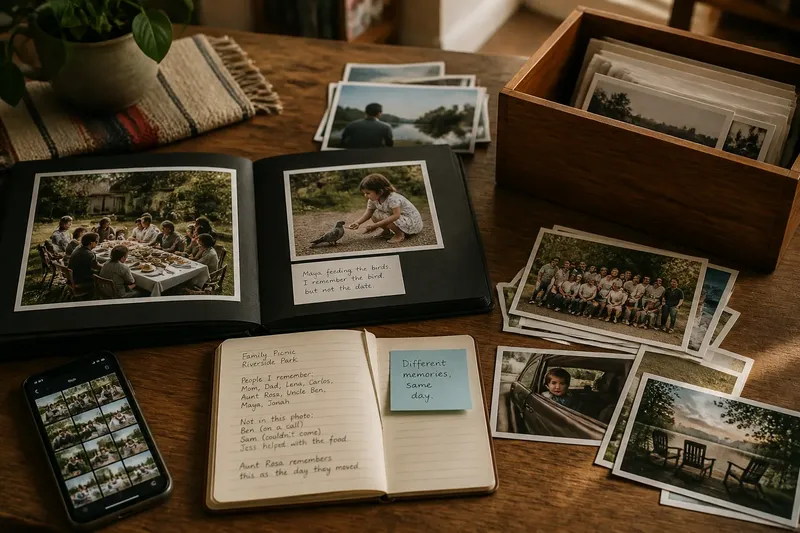
For instance, imagine a person assembling an album about a family picnic. They include a group portrait and a picture of a child feeding crumbs to a bird, then caption the second image with the child’s name and a note that the photographer remembered the bird but not the date. The album still offers a point of view, but its small uncertainties are visible rather than disguised as certainty.
A digital folder preserves variety and makes revision easier
A folder of digital images suits families who want to keep many photographs without arranging them into a polished narrative. Separate folders by occasion, or use descriptive filenames that identify a place and the people visible. A shared folder can let relatives contribute images taken from different positions, including photographs that a single album-maker might not choose.
More files do not automatically create a more complete account. A folder can still privilege whoever has the camera, the account password, or the time to sort images. It can also leave future viewers staring at anonymous files with no names or context. Add simple captions in a document or file notes, and agree who can add, edit, or remove images before several people begin managing the collection.
Digital collections are especially useful when relatives live apart or want to revisit the same image from different places. They are less suited to people who prefer a tangible object or do not want family photographs stored on a shared service. If those preferences differ, a small album and a separate folder can serve different needs instead of forcing one format to do everything.
A shared archive makes room for more than one account
A shared archive suits families who want to preserve images alongside memories and corrections from different relatives. It might be a physical box with labeled envelopes and blank cards, or a digital collection where several people can add captions. Its purpose is not to reach a single verdict. It is to preserve the image and the different ways people interpret it.
That approach asks for care. A caption should distinguish “Aunt Rosa remembers this as the day they moved” from “The photograph was taken on moving day.” Those sentences make different claims. If someone objects to a label, record the disagreement or use a more modest description rather than treating one person’s memory as a settled fact.
Shared archives suit families with varied memories or relatives who have been left out of the familiar story. They may be cumbersome if contributors disagree about access or privacy. In that case, begin with a small group of images and invite comments before making the entire collection available.
Display turns a snapshot into a family emblem
Keeping a picture in a box and displaying it on a mantel are different acts. A visible photograph becomes part of the room’s everyday language: this is who we remember, this is the gathering we celebrate, this is the version of home we want visitors to see. Repetition gives an image weight even when nobody says anything about it.
That can be comforting. A portrait of a grandparent may help a child connect a name to a face, and a favorite group shot can invite stories at the dinner table. But a familiar display can also make an absent relative seem unimportant, or make one branch of a family appear to represent everyone. A photograph on the wall works like a place setting: it marks who has been invited into the scene, though it cannot tell you everything about the gathering.
Before choosing a permanent display, ask who appears in the image, who chose it, and who is likely to see it. If a family member objects to having their likeness displayed, take the objection seriously. A photograph can remain meaningful in private without being used as a public emblem. Where relatives have different comfort levels, a rotating display or a small set of prints available for personal viewing may be a better fit.
How should you choose a way to keep them?
Should I choose an album or a digital folder?
Choose an album if you want a tactile sequence that people can browse together. Choose a digital folder if several relatives need to contribute, search, or view images from separate homes. If both purposes matter, keep the formats distinct and let each one do its own job.
What should I write in a photo caption?
Record details you can identify, such as the names of people who are known to you and a place someone recognizes. Mark uncertain dates or memories as uncertain, and name whose recollection a detail comes from. A short, careful caption is more useful than a confident guess.
How do I handle a relative who does not want a picture shared?
Ask what kind of sharing they object to: a public post, a family group, a printed display, or any copy at all. Respect their stated boundary and consider keeping the image private or excluding it from the shared collection. A family archive is not more honest just because it includes an image someone does not want circulated.
Can one photograph represent a whole family?
It can represent a particular group at a particular moment, especially if the people pictured agree that the image matters to them. It cannot speak for relatives who are absent or explain the full relationships among those present. Pair it with other views or a caption that identifies its limits.
Choose by the kind of belonging you want to leave visible
To choose among an album, a digital folder, and a shared archive, ask what you want a future viewer to be able to do. If the aim is to revisit a deliberate sequence together, an album may fit. If relatives need easy access to many images, a folder may be more practical. If the aim is to preserve contrasting memories, a shared archive offers room for more than one voice.
Then consider who should make the decisions. One person can curate an album with care, but a family collection need not depend on a single editor. Invite relatives to identify people, correct captions, or suggest images that are missing. They do not have to agree on every memory to help make the collection more legible.
The neutral family photograph does not exist; every snapshot has a frame, and every collection has an arrangement. That need not be a reason to distrust family pictures. It is a reason to keep the useful details around them: who took the image, what can be seen, what remains uncertain, and who wants to be included. A modest caption or a second point of view can give the next person a better place to begin.