The Borrowed Life of the Marginal Note
The marginal note turns private reading into visible reception, preserving questions, disagreements, and links that later readers can interpret in context.
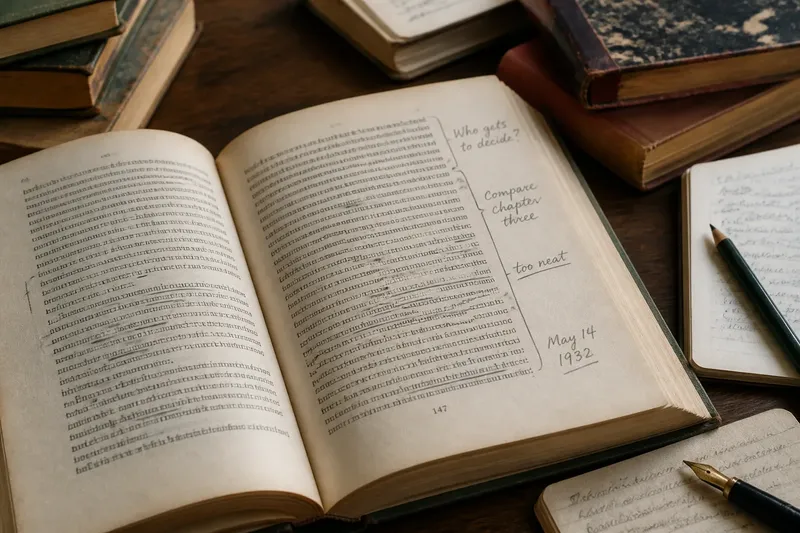
The most common mistake with a marginal note is to treat it as a disposable reminder: a quick underline, a question in pencil, a name beside a passage. That can cost later readers the chance to see how a text was understood, challenged, or put to use. The marginal note has a borrowed life: it begins with one reader, then may become part of the text’s public reception.
These field notes follow that small change of scale. They focus on what marks in a book can tell us, what they cannot, and how to preserve their context without mistaking a reader’s trace for the author’s voice.
A note starts as an aid to attention
A margin offers a reader a narrow place to speak back. A question mark can hold uncertainty; a line beside a sentence can flag an idea worth returning to. A few words such as “compare chapter three” turn a book into a working surface, connected to the reader’s other thoughts and readings.
These marks are not all the same kind of evidence. A bracket may identify a passage as useful, while “too neat” suggests resistance. A date or a name may place the reading in a particular setting, but not explain what that setting meant. The mark records an action more securely than it records a full motive.
That distinction matters. A reader might underline a sentence because it is moving, because it is confusing, or simply because it will be needed for an assignment. The mark alone rarely settles which explanation is right. Treat it like a note tucked into a recipe book: useful evidence that someone paused, not a complete account of why.
The private reader leaves clues, not a confession
Marginalia can make reading feel unusually close. Handwriting, a blunt “no,” or a penciled alternative seems to bring a person into the room. But intimacy is not the same as certainty. A reader’s identity may be unknown, and even a known name does not reveal whether the comment was sincere, playful, hurried, or copied from somewhere else.
Pay attention to the relationship between mark and passage. Does the note paraphrase the text, question it, or point outward to another source? Is it written beside a claim, a definition, or a turn in the argument? Those details support careful description. They do not license a biography built from one annotation.
Imagine a library copy of a novel with “Who gets to decide?” penciled beside a character’s judgment of another person. A later reader could describe the question and its placement, then ask whether other marks in the volume respond to the same theme. It would be a leap to claim the annotator belonged to a particular group or held a settled position. The visible evidence is narrower, and more interesting, than that guess.
How can a marginal note become public?
What changes when a marked book enters a collection?
When a privately owned volume is donated, sold, or placed in a library collection, its marks may travel with it. The note becomes available to readers who did not know the annotator and may never learn their identity. Its meaning shifts from a personal aid toward evidence of a book’s reception, while remaining tied to the particular copy.
Can a note change how later readers understand a text?
Yes, because a visible response can direct attention toward a phrase, contradiction, or omission. A later reader may notice the annotation before forming an independent view, so the mark can participate in reception rather than merely record it. That influence does not make the annotator’s reading definitive.
What can a digital image preserve?
A clear image can show a mark’s location, wording, and relation to the printed passage. It may not preserve paper texture, ink depth, binding, or the experience of turning the page, and a cropped image can remove useful context. A good description states what is visible and identifies what the image leaves out.
Should every annotation be transcribed?
Not necessarily. Selection may be needed for privacy, condition, or the limits of a project, but the reason should be clear to readers. If only some marks are transcribed, avoid presenting the selection as a complete record of the copy’s annotations.
Reading a mark requires reading its page
A marginal note is easy to detach from its surroundings. A photograph cropped to a single phrase can make a response look more pointed than it was. Before drawing meaning from a mark, check the printed sentence, the paragraph around it, and any nearby marks that might qualify or extend the comment.
Placement can be part of the message. A note squeezed between lines may be an afterthought; a bracket running down a paragraph may signal that the whole passage matters. A symbol might refer to a footnote, a later page, or a private system of marks. When the link is unclear, describe the uncertainty rather than silently resolving it.
Also notice whether the hand changes. A book may have passed through several readers, and one person may have annotated it at different times. Different inks or writing styles can suggest separate episodes, but appearance alone cannot prove how many people were involved. Record the visible difference as an observation, not a firm attribution.
Preserve the trace without flattening it
For anyone describing an annotated book, a few practical habits help keep observation separate from interpretation:
- Record the edition and the specific copy, so a reader can distinguish this marked volume from other copies of the same text.
- Note where the mark appears, including the page and the passage it touches, rather than quoting an isolated phrase.
- Transcribe the annotation faithfully; use brackets or a brief note to show where handwriting is unclear instead of guessing.
- Describe the medium and visible form, such as pencil, ink, a bracket, or an underline, when those details can be observed.
- Separate description from interpretation: write “question mark beside the claim” before proposing that it signals doubt.
- Keep a record of omissions or redactions, so readers know whether the displayed material represents the whole copy or a selected portion.
These practices matter in print and online. A scan should retain enough of the page for readers to see what the note addresses. A catalog record can identify that a copy contains annotations without treating every private remark as a searchable public statement. Where access could expose sensitive personal information, a librarian, archivist, or other qualified collection professional can help weigh description against privacy.
Reception accumulates one copy at a time
The history of a text is not only the story of its author, publisher, or formal reviews. It also includes the uneven record of readers using particular copies: a student marking an argument, a family member writing a correction, a reader pointing to another book. Marginalia makes that activity visible, but only in the places where marks survived and someone chose to preserve them.
That unevenness should temper broad claims. One annotation does not stand for all readers, and a silent copy does not prove that nobody responded. The surviving marks reveal specific encounters, not a representative survey. Their value lies in showing how reading can leave material traces and how later readers may inherit those traces.
When you encounter a marginal note, begin with the modest questions: what is marked, where does it sit, and what does the writer appear to be doing on the page? That approach lets the borrowed life of the marginal note remain visible without making its unknown reader say more than the evidence allows.